
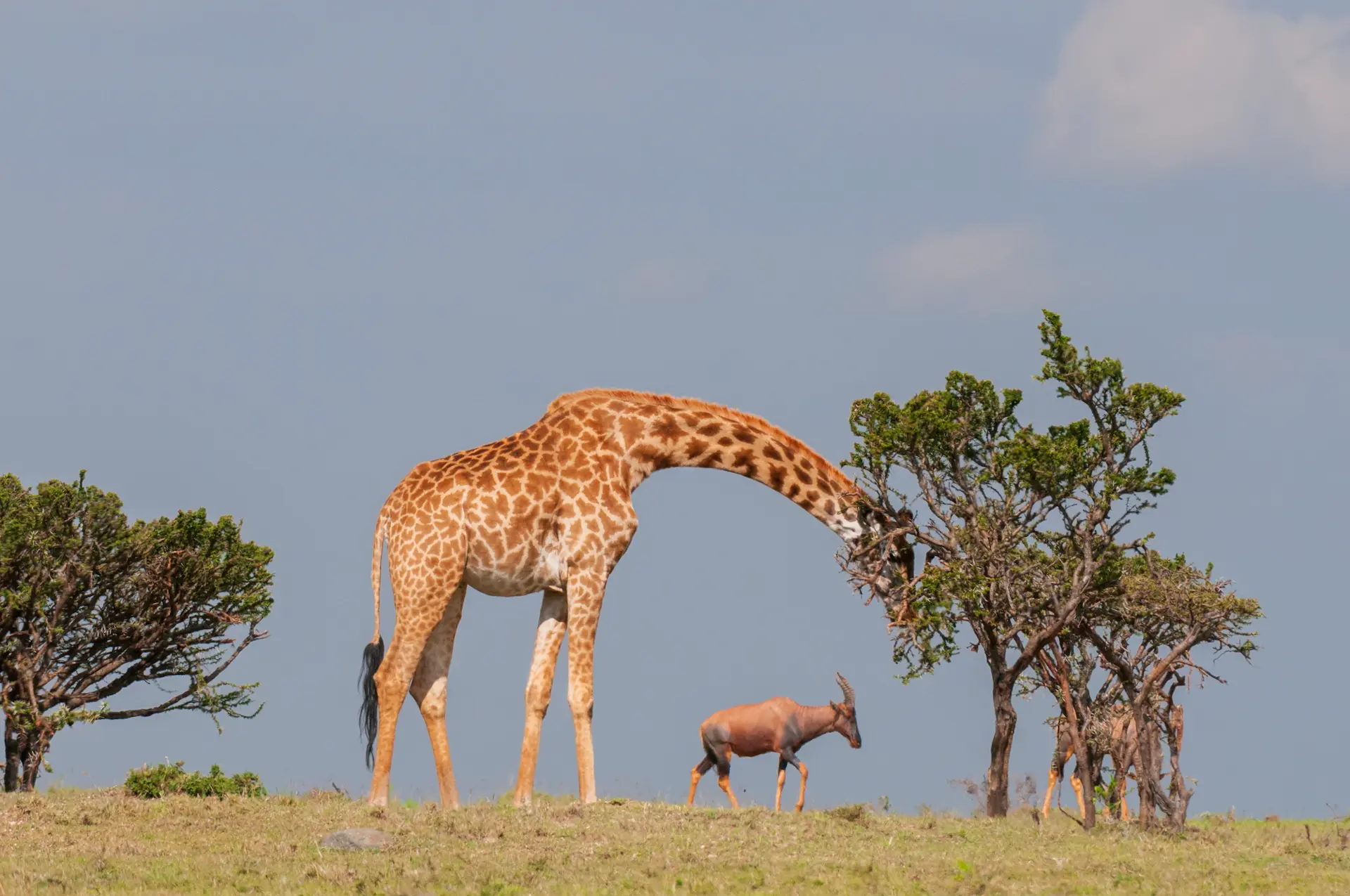
A giraffe’s neck can stretch over six feet long, but it wasn’t always that way. Millions of years ago, their ancestors had much shorter necks. Over time, nature favored the ones that could reach higher, fight stronger, and spot danger sooner. The result is one of the most recognizable silhouettes in the animal kingdom.
Their long necks became more than a quirky feature. They became a story of survival and evolution, one that still shapes how giraffes live on the African plains today.
Read on to learn more about why giraffes have long necks and how conservation efforts by Save Giraffes Now are helping protect these incredible animals and the lands they call home.
Key Takeaways
- Giraffes developed their long necks through gradual adaptation over millions of years.
- Their height gives them access to food high in the trees and helps them stay alert to danger.
- Studies suggest that female giraffes may have influenced this evolution by needing access to the most nutritious leaves.
- Giraffes also use their necks for social interaction and to establish dominance within herds.
- Protecting giraffes means protecting the lands and trees that sustain them. Join Save Giraffes Now and help keep these gentle giants safe in the wild.
Evolution built it, not nature’s design for beauty
The giraffe’s long neck is the result of millions of years of gradual change. Fossils show that ancient relatives such as Samotherium, which lived about seven million years ago, had much shorter necks. Over time, small advantages began to make a difference. Giraffes that could reach higher branches or see predators sooner were more likely to survive and raise offspring.
Research published in journals shows that neck length increased slowly as Africa’s environment shifted from thick forests to open savannas. In these new landscapes, taller individuals could access treetops where food was abundant and competition was low.
The feeding theory
One of the most widely accepted explanations for the giraffe’s long neck is the feeding advantage. In the open savannas of Africa, tall trees such as acacia and mimosa provide a crucial source of food. By growing taller, giraffes gained access to leaves that other herbivores could not reach, reducing competition and ensuring a steady supply of nutrition even during dry seasons.
Field studies have confirmed this advantage. Researchers observed that giraffes spend most of their feeding time at heights above ten feet, far beyond the reach of antelopes or zebras. Their necks and tongues work together to strip leaves from high branches, allowing them to thrive in environments where food is often scarce.
New research suggests another reason
For years, scientists believed giraffes’ long necks evolved mainly to help them reach high branches. Recent studies, however, suggest there may be more to the story.
Researchers from Penn State University examined the proportions of male and female giraffes and found something surprising. Female giraffes actually have relatively longer necks compared to their body size than males do. This finding challenges the older idea that long necks evolved mainly through male competition. Instead, it suggests that feeding efficiency is a stronger evolutionary driver, particularly for females who require additional nutrition during pregnancy and lactation.
The fighting theory
Male giraffes exhibit a unique behavior known as necking, where they swing their heads and necks at each other in slow, powerful arcs. These contests help establish a hierarchy and determine which males are allowed to mate.
Researchers have found that males with thicker necks and heavier skulls tend to win these battles more often. The outcome decides who earns mating rights, which in turn influences which traits get passed to the next generation.
While “necking” looks fierce, it rarely causes serious harm. After the contest, the dominant male often resumes feeding beside his rival; the conflict is settled through strength and balance rather than aggression.
How do they survive with such long necks?
Having such a long neck might look effortless, but it requires special adaptations to work. Despite their height, giraffes have only seven neck bones, just like humans. The difference lies in their size, as each vertebra can be more than ten inches long and connected by powerful joints that allow flexibility and support.
Their circulatory system is just as remarkable. A giraffe’s heart can weigh more than 20 pounds and generates twice the blood pressure of a human heart. This strength is necessary to pump blood up the six-foot distance to the brain. Special valves in their neck arteries prevent blood from rushing back down when they lower their heads to drink, protecting them from fainting or injury.
Even their tissues help them manage the strain of being so tall. The skin and fascia on their legs are packed tight, which keeps blood and fluid from pooling. NASA has studied those pressure-control adaptations to understand better how the body handles extreme gravitational stress. Their respiratory system also moves enough oxygen through a long, heavy frame that’s working nonstop to stay upright.
Help Keep the World’s Tallest Animal Standing Tall
The giraffe’s long neck tells the story of millions of years of evolution. Yet this story is now at risk. Over the past 30 years, giraffe populations have declined by almost 40 percent as their habitats have shrunk and threats have increased. Without protection, the world’s tallest animal could quietly disappear from the wild.
Save Giraffes Now is working to prevent that future. Across Africa, our teams are rescuing injured giraffes, reintroducing them to protected reserves, and restoring the tree-filled landscapes they depend on. Each project gives new life to areas where giraffes once roamed freely, turning loss into hope.
Every donation helps continue this work. Your support provides the resources needed to protect habitats, fund rangers, and keep giraffes safe in their natural habitats. Together, we can make sure their long necks keep reaching for the treetops, not for survival, but for a future they deserve. Donate now and help us make this mission a success.
Frequently Asked Questions
What is the purpose of a giraffe’s long neck?
A giraffe’s long neck helps it reach leaves, shoots, and fruits high in the trees where few other animals can feed. It also helps them stay alert by spotting predators from a distance and plays a role in social behavior among males.
Why are there no giraffes with short necks?
Over millions of years, giraffes with longer necks had better access to food and a higher chance of survival. Those traits were passed down through generations, eventually becoming a defining feature of the species.
Has there ever been a giraffe with a short neck?
Yes. Fossils show that ancient giraffe relatives, such as Samotherium, had much shorter necks. These early species lived about seven million years ago before giraffes evolved their modern form.
Why do giraffes have long necks in kids?
Explaining it simply: Giraffes have long necks because they help them reach food and stay safe. Long ago, shorter-necked giraffes couldn’t eat as much, so taller ones survived and had babies that inherited their height.