
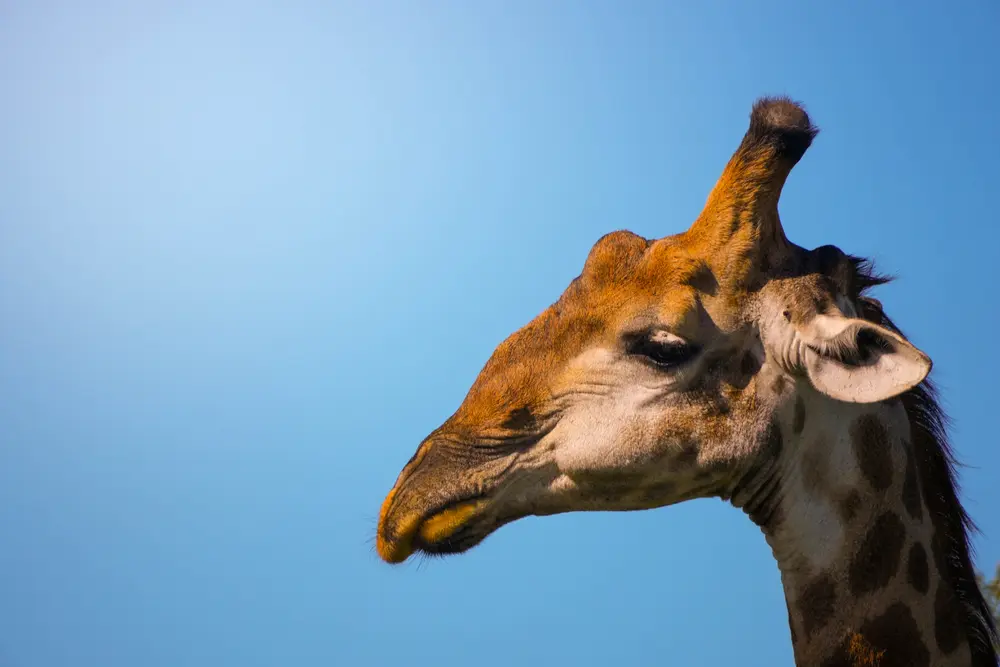
No, giraffes do not have true horns. They have ossicones, which are permanent, skin-covered bony structures attached to the skull.
Unlike the horns of cattle or goats, ossicones are made of bone covered with skin and hair. They are never shed like antlers and continue changing as giraffes grow older.
Let’s discuss what ossicones are, how they differ from horns, and why they matter.
Key Takeaways
- Giraffes do not have true horns. They have ossicones, which are permanent, skin-covered bony structures.
- Both male and female giraffes have ossicones, although males typically have larger, thicker ones.
- Baby giraffes are born with ossicones that lie flat against the head before fusing to the skull as they grow.
- Unlike antlers, ossicones are never shed.
- Ossicones help protect giraffes during combat and may also signal age, strength, and social status.
- Protecting giraffes means protecting the lands and trees that sustain them. Join Save Giraffes Now and help keep these gentle giants safe in the wild.
What Are the Horns on a Giraffe Called?
The horn-like structures on a giraffe’s head are called ossicones.
An ossicone begins as cartilage before gradually turning into bone. It remains covered by skin and fur throughout the giraffe’s life, although older males often lose the hair on top because of frequent fighting.
Only giraffes and okapis have ossicones, making them one of the most distinctive features of the giraffe family.
What Are Ossicones Made Of?
Although people often mistake them for horns, ossicones have a very different structure.
They are:
- Made primarily of bone
- Covered with living skin and hair
- Permanently attached to the skull in adults
- Present in both male and female giraffes
Scientists believe ossicones help protect the skull during combat while also serving as a visual sign of age and maturity.
Are Ossicones the Same as Horns?
No. Ossicones, horns, and antlers may look similar, but they develop differently and serve different functions.
| Feature | Horns | Antlers | Ossicones |
| Made of | Keratin over bony core | Bone | Bone |
| Covered by skin | No | No (after growth) | Yes |
| Shed naturally | No | Yes | No |
| Found on | Cattle, goats, antelope | Deer | Giraffes and okapis |
This distinction is one reason ossicones are so fascinating to biologists. They represent a unique evolutionary adaptation found in only two living animals.
Are Baby Giraffes Born With Ossicones?
Yes. Baby giraffes are born with ossicones, but they look different from those of adults.
At birth, the ossicones lie flat against the head and are not yet fused to the skull. This helps protect both the mother and calf during delivery. Over time, they gradually stand upright and become firmly attached as the calf grows.
Do Male and Female Giraffes Have Ossicones?
Both male and female giraffes have ossicones, but they are not identical.
Male giraffes usually have larger, thicker ossicones that become bald on top with age. During contests for dominance, males swing their necks and strike opponents with their heads, a behavior known as necking. Years of repeated contact wear away the hair and can lead to additional bone growth, making the ossicones appear heavier.
Female giraffes typically have slimmer ossicones with tufts of hair remaining on top throughout their lives because they rarely engage in this type of combat.
Why Do Giraffes Have Ossicones?
Researchers believe ossicones serve several important functions.
They help:
- Protect the skull during fights between males.
- Signal age, strength, and social status.
- Support mating competition by giving dominant males an advantage.
- Distinguish individuals and, in some cases, different giraffe species.
Combined with a giraffe’s long neck and powerful body, ossicones are part of a suite of adaptations that have evolved over millions of years.
How Many Ossicones Does a Giraffe Have?
Most giraffes have three ossicones: a pair on top of the head and a smaller median ossicone in the center of the forehead. However, the number can vary depending on the giraffe’s species, sex, and age.
For example, a Nubian giraffe can have five ossicones. In addition to the usual three, it develops an extra pair behind the ears, giving it a distinctive appearance.
These additional ossicones become more pronounced in mature males and are thought to provide extra protection during necking contests while also serving as a sign of age and dominance.
Can Giraffes Lose Their Ossicones?
No. Ossicones are permanent.
Unlike deer antlers, which are shed and regrown each year, giraffe ossicones remain attached for life. They may change shape, become thicker, or lose their covering of hair, but they are not naturally shed.
Help Protect Giraffes for Future Generations!
Every fascinating fact about giraffes, including their unique ossicones, reminds us just how extraordinary these animals are. Yet despite their remarkable adaptations, giraffe populations continue to face growing threats from habitat loss, poaching, climate change, and human-wildlife conflict.
At Save Giraffes Now, our mission is to ensure that giraffes thrive in the wild for generations to come. We support science-based conservation efforts that protect critical habitats, strengthen anti-poaching initiatives, fund research, and work alongside local communities to create a future where both people and giraffes can flourish.
A donation to Save Giraffes Now helps fund on-the-ground conservation projects across Africa, giving these iconic animals a better chance to survive and recover. Every contribution, no matter the size, supports meaningful action to protect one of the world’s most recognizable and beloved species.
Donate today to help keep giraffes standing tall for generations to come.
Frequently Asked Questions
What are 5 interesting facts about giraffes?
Here are five fascinating facts about giraffes:
- Giraffes are the tallest land animals, with males reaching up to 18 feet (5.5 meters) tall.
- They have ossicones, not true horns. These skin-covered bony structures are unique to giraffes and okapis.
- A giraffe’s tongue can grow up to 20 inches (50 centimeters) long, helping it grasp leaves from thorny acacia trees.
- Every giraffe has a unique coat pattern, much like a human fingerprint.
- Despite their long necks, giraffes have only seven neck vertebrae, the same number as humans.
What animal sleeps only 30 minutes a day?
Giraffes are among the mammals that sleep the least. Wild giraffes typically sleep for 30 minutes to 2 hours per day, often in short naps lasting just a few minutes. Staying alert helps them watch for predators such as lions and spotted hyenas.
Can a giraffe pick a person up?
No. Giraffes cannot pick up people because they do not have hands or grasping limbs. Although they can use their long necks and powerful bodies to push or strike during defensive behavior, giraffes generally avoid people and are not naturally aggressive unless they feel threatened.
How can you tell a female giraffe from a male giraffe?
One of the easiest ways to tell them apart is by looking at their ossicones. Male giraffes usually have larger, thicker ossicones that become bald on top as they age due to fighting. Female giraffes typically have slimmer ossicones with tufts of hair remaining on the tips. Males are also generally taller and heavier than females.