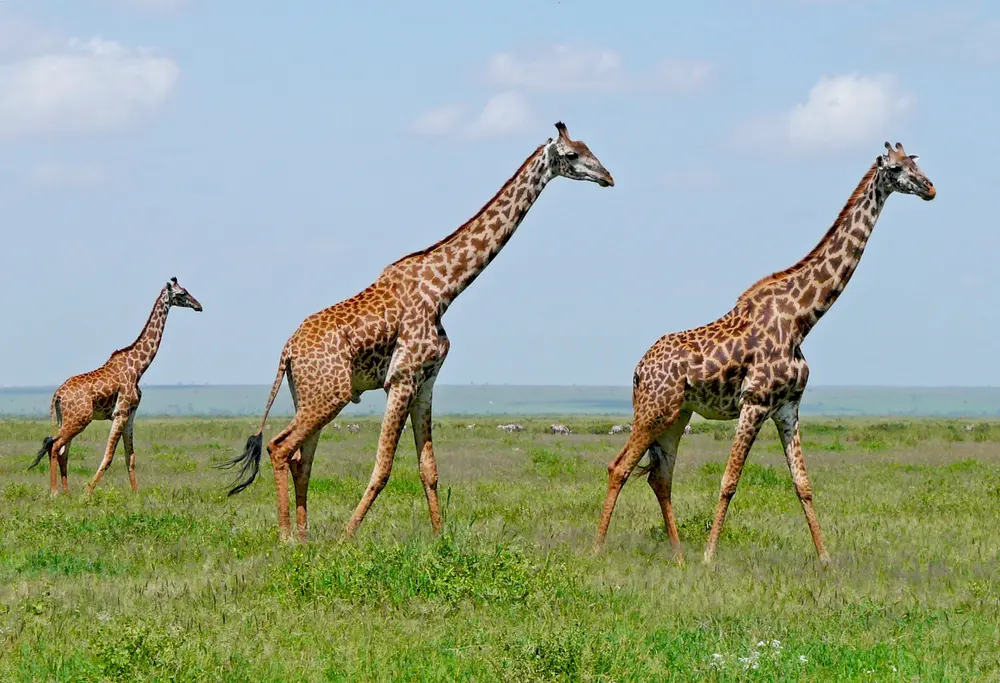
Giraffes (Giraffa spp.) are the tallest land animals on Earth, yet the scale of their population decline over the past four decades has largely escaped mainstream public attention. The term most often used by scientists to describe this trend is the “silent extinction.”
Between the 1980s and the 2010s, the global giraffe population fell by an estimated 36–40%, dropping from approximately 155,000 individuals to below 100,000. [1] More recent and comprehensive survey methods have since revised that figure upward to around 117,000–140,000, depending on the methodology applied, but the underlying trend remains troubling: three of the four recognized giraffe species are classified as threatened or critically endangered.
Summary: A Population in Numbers
The following figures summarize the key data points in the giraffe population timeline:
| Year / Period | Estimated Population | Key Milestone / Note |
|---|---|---|
| 1985 | ~155,000 | Earliest reliable baseline; IUCN Least Concern |
| 1999 | ~140,000 | A decade of habitat loss begins to show in data |
| 2006–2015 | ~80,000–97,000 | Steepest recorded decline; US giraffe trade peaks |
| 2015 | 97,562 | IUCN revised figure; triggers 2016 Red List review |
| 2016 | 97,562 | IUCN reclassifies to Vulnerable; 40% decline confirmed |
| 2019 | N/A | CITES Appendix II listing; first international trade regulation |
| 2020 | 117,173 | Revised count; reflects improved survey methods + conservation gains |
| 2025 (SGN) | ~117,000 | Current wild population per Save Giraffes Now |
The 1980s Baseline: When 155,000 Was the Starting Point
The 1980s represent the earliest period for which reliable, continent-wide population estimates exist for giraffes. In 1985, the IUCN and partner organizations recorded between 151,702 and 163,452 individuals across Africa, with a widely cited central figure of approximately 155,000. [1] These numbers reflected a population spread across more than 20 countries, inhabiting the savannas, open woodlands, and semi-arid zones of sub-Saharan Africa.
At this point, giraffes were classified by the IUCN as a species of Least Concern. A designation that implied stability and no immediate extinction risk. The classification was partly a product of limited data. Systematic surveying of giraffe populations was inconsistent across the continent, and giraffes were not a priority focus for conservation research relative to high-profile species like elephants and rhinoceroses. [2] The lack of attention would prove costly in the decades that followed.
Historically, giraffes had occupied a far larger range. In the 18th century, their numbers were estimated at over one million across Africa, and they were present in virtually every major savanna and woodland system on the continent. By the late 19th century, a rinderpest epidemic introduced through European cattle had already decimated populations of cloven-hoofed animals across Africa, setting a precedent for how external shocks could rapidly reshape giraffe numbers.
The 1990s: Accelerating Pressure
The 1990s marked the beginning of a measurable and sustained decline. By 1999, the estimated continental population had fallen to approximately 140,000. This drop was not uniform. Regional variation was significant, with some populations declining far more sharply than the continental average suggested.
The primary driver during this decade was habitat loss and fragmentation. Africa’s human population was growing at a rate that put increasing pressure on land across the continent. Agricultural expansion, the clearing of woodlands for subsistence farming, and the spread of livestock grazing into formerly wild areas progressively reduced and fragmented the territory available to giraffes. [3] Herds that had once ranged freely across large connected landscapes began to encounter barriers such as fences, roads, and cultivated fields that limited movement and gene flow between populations.
The situation for certain regional populations was considerably more severe than continent-wide numbers implied. In Uganda, for example, giraffe numbers collapsed by approximately 90% between the 1960s and the early 1990s, falling from roughly 1,800 individuals to fewer than 100 at the population nadir. [4] Civil conflict in the 1970s and 1980s had devastated wildlife populations, and giraffes were no exception. Three of five established populations in the country went locally extinct during this period.
By the end of the decade, giraffes had gone locally extinct in several countries where they had previously been present, including Angola, Nigeria, and Mali. [5] These losses were largely undocumented at the time, with no coordinated international response and little systematic effort to assess range contraction at the country level.
The 2000s: The Decline Becomes Undeniable
The first decade of the 2000s delivered increasingly clear evidence that the giraffe’s conservation status was misclassified. Field surveys across multiple countries began producing data that, when aggregated, pointed to a consistent downward trajectory. The overall African population, estimated at around 140,000 in 1999, had declined to approximately 80,000–97,000 by the mid-2000s, depending on the assessment method used. This represents a drop of more than 40% from the 1985 peak. [6]
The Reticulated giraffe, restricted to northern Kenya, southern Ethiopia, and Somalia, illustrated the severity of regional declines. Smithsonian Institution researchers and partners documented a population reduction of between 50% and 80% for this species since the mid-1990s. The causes were a combination of habitat loss driven by agricultural encroachment, deforestation, and urbanization, alongside targeted poaching linked to both bushmeat markets and international trade in giraffe parts.
The United States, though geographically distant from giraffe habitats, was a significant contributor to poaching pressure during this period. Between 2006 and 2015, the US imported 21,402 giraffe-bone carvings, 3,008 giraffe-skin pieces, and 3,744 hunting trophies, representing the body parts of at least 3,751 individual animals. At the time, there was no US federal protection for giraffes, meaning this trade was largely unregulated and difficult to track.
The key pressures documented across the decade included:
- Habitat loss through agricultural expansion, logging, and infrastructure development across East, West, and Central Africa
- Growing commercial bushmeat markets, with giraffe meat traded alongside other savanna species in several countries
- Traditional demand for giraffe parts — tails for cultural ceremonies, bone marrow marketed falsely as an HIV treatment in parts of Tanzania, blood used in ritual practices in the Kalahari region
- International trophy hunting and the unregulated trade in giraffe-derived products, primarily through US markets
- Ongoing armed conflict in the Democratic Republic of Congo, South Sudan, and the Central African Republic has made conservation monitoring and enforcement effectively impossible in some of the most critical giraffe habitats
Despite the accumulating evidence, giraffes remained on the IUCN’s Least Concern list throughout this period. The absence of a comprehensive continent-wide population assessment meant the full scale of the decline was not formally captured in global conservation frameworks.
2016: The Watershed Moment
December 2016 marked the most significant turning point in the documented history of giraffe conservation. At the 13th Conference of the Parties to the Convention on Biological Diversity in Cancún, Mexico, the IUCN announced that giraffes had been reclassified from Least Concern to Vulnerable on the Red List of Threatened Species. [7]
The reclassification was based on revised population data showing that the global giraffe count had fallen to 97,562 individuals in 2015, down from 151,702–163,452 in 1985. This represented a decline of 36–40% over three decades. [8] Specialist Group described the situation in terms that captured both the urgency and the paradox: giraffes were everywhere in popular culture, yet quietly disappearing in the wild.
The 2016 assessment also drew attention to the marked difference in outcomes between giraffe subspecies. Of the nine subspecies recognized at the time, three had increasing populations while five were in decline and one was stable. The subspecies-level picture told a far more alarming story than the species aggregate:
- Kordofan giraffe: had lost approximately 90% of its population since the late 1980s, with only around 2,000 individuals remaining, classified as Critically Endangered.
- Nubian giraffe: had declined by 98% and survived only in protected areas in Kenya and Uganda, classified as Critically Endangered
- Reticulated giraffe: had declined by more than half in three decades, classified as Endangered. [5]
- Masai giraffe: the most numerous species at the time, but had dropped from an estimated 71,000 to around 35,000, classified as Endangered
- West African giraffe: had reached a low of just 49 individuals in 1995, representing the most acute subspecies-level bottleneck in the giraffe story, classified as Vulnerable. [5]
- Southern giraffe: the exception to the overall decline, with populations in Namibia, Botswana, South Africa, and Zimbabwe remaining relatively stable or recovering in some areas
The IUCN also confirmed at this time that giraffes had gone extinct in at least seven African countries: Burkina Faso, Eritrea, Guinea, Malawi, Mauritania, Nigeria, and Senegal. [9] Each local extinction represented the permanent loss of a population that had existed within living memory.
2018–2020: Species Reclassification and Revised Counts
A parallel scientific development was reshaping the framework through which giraffe conservation was understood. In 2016, researchers published genetic evidence demonstrating that giraffes were not a single species with nine subspecies, as the IUCN had long classified them, but rather four distinct species: Giraffa camelopardalis (Northern giraffe), Giraffa reticulata (Reticulated giraffe), Giraffa tippelskirchi (Masai giraffe), and Giraffa giraffa (Southern giraffe). [10]
The IUCN formally recognized this four-species taxonomy in subsequent assessments, which significantly changed how population data were analyzed and reported.
Under the revised framework, individual species-level assessments were published between 2018 and 2020, and the aggregate picture became considerably more nuanced. Conservation status review reported a total population of 117,173 individuals across all four species — a 20% increase from the 2015 figure of 97,562. [11] Other researchers were careful to note that this increase reflected both genuine conservation progress and substantial improvements in survey methodology, particularly in areas that had previously been undercounted.
The 2020 review found population growth across all four species for the first time in recorded history, with Masai giraffe numbers rising significantly thanks to targeted conservation interventions in Kenya and Tanzania, and Northern giraffe populations showing modest recovery following translocation programs in Uganda, Chad, and Niger. [12] Southern giraffes, meanwhile, remained the most numerous species and continued to account for more than 50% of the continental total.
Yet the headline figure masked ongoing fragility. Even with the upward revision, three of the four species remained highly threatened:
- Northern giraffe: approximately 5,600–7,037 individuals across Central, East, and West Africa, representing a 70% decline since the mid-1990s despite recent modest recovery[13]
- Reticulated giraffe: approximately 15,780–16,000 individuals, down by more than half from historic highs
- Masai giraffe: approximately 35,000–45,000 individuals, recovering but still well below the 71,000 recorded three decades earlier
- Southern giraffe: approximately 54,750 individuals, the only species showing broadly stable or improving numbers across its range. [5]
The 2020s: Present Status and the Fragility of Recovery
As of the mid-2020s, reports estimate the total African giraffe population at approximately 140,000 individuals. Save Giraffes Now, operating across ten African countries, continues to document a figure closer to 117,000 for wild individuals. [15] The discrepancy between sources reflects differing survey methodologies, inclusion criteria for captive-bred and translocated populations, and the ongoing challenge of counting animals in remote, conflict-affected, or poorly accessible regions.
The Northern giraffe remains the most immediately threatened. A 2025 report records 7,037 individuals across three subspecies—Kordofan, Nubian, and West African—distributed in fragmented populations across Central, East, and West Africa. While this represents a 19% increase over five years, it masks a 70% decline from mid-1990s baselines. [16] The Kordofan subspecies is now primarily concentrated in Zakouma National Park in Chad; populations in Cameroon and the Central African Republic have contracted to the point where only a handful of individuals may remain in the latter country.
The West African giraffe offers the clearest evidence that recovery is possible under sustained conservation effort. From a low of 49 individuals in 1995, the population has grown to approximately 600 today — a remarkable turnaround driven by community-based conservation in Niger, habitat protection, and strict anti-poaching enforcement. [5] The population remains critically small, however, and any significant disruption to the single habitat it occupies could rapidly erase decades of progress.
In 2019, giraffes were listed on Appendix II of the Convention on International Trade in Endangered Species (CITES) — the first formal international trade regulation applied to the species. The listing requires that all international trade in giraffes or giraffe-derived products be demonstrated as legal and sustainable. Conservation organizations regard the listing as an important but insufficient measure, noting that domestic trade within range countries remains largely unregulated.
In the United States, the Fish and Wildlife Service has recommended federal protections for several giraffe subspecies under the Endangered Species Act. The proposed listings include all three Northern giraffe subspecies as Endangered, and the Reticulated and Masai giraffes as Threatened with tailored protections. If enacted, the ESA listing would introduce US import permits, support research funding, and restrict the trade in giraffe parts through US-based markets.
Updated population estimates from IUCN are expected in October/November this year. This article will be updated with the new information when it becomes available.
Understanding the Decline: Structural Causes
The population trajectory described across this timeline is not the product of a single cause. It reflects the convergence of several long-running structural pressures that have operated simultaneously and, in many cases, reinforced one another.
Habitat Loss and Fragmentation
Habitat loss is the dominant long-term driver of giraffe population decline. In the last 300 years, giraffes have lost approximately 90% of their historical range across Africa. The primary mechanism is land conversion for agriculture, livestock grazing, and human settlement. As human populations have grown across sub-Saharan Africa, the competition for land has intensified, and the dry savannas and open woodlands that giraffes depend on have been progressively cleared, fenced, or degraded.
Fragmentation is a secondary consequence with its own distinct effects. When continuous habitat is divided by roads, fences, farming areas, or infrastructure projects, giraffe populations become isolated from one another. Isolated populations cannot exchange individuals, which reduces genetic diversity, limits adaptive capacity, and makes local extinction more likely following any significant disturbance.
Commercial Bushmeat Poaching
Commercial bushmeat poaching is the second major driver of decline and has intensified significantly since the 1990s. Giraffes are targeted for their meat, which is traded in urban markets across several Central and East African countries. Their hides, tails, and bones are also harvested for cultural uses, decorative products, and, in some contexts, for false medicinal claims. The scale of poaching has historically been underreported because giraffes exist at low densities across large, remote landscapes that are difficult to monitor consistently.
Civil Conflict and Governance
Armed conflict and the breakdown of state governance have had direct and lasting impacts on giraffe populations. In conflict-affected regions, conservation personnel are displaced, protected areas are left unpatrolled, and poaching surges due to the absence of enforcement. The Northern giraffe has been particularly affected, with populations in South Sudan, the Central African Republic, and parts of the Democratic Republic of Congo suffering severe declines correlated with periods of active conflict.
Slow Reproductive Rate
An often-overlooked biological factor is the giraffe’s inherently slow reproductive rate. Female giraffes carry calves for approximately 15 months and typically give birth to a single calf. Most females produce around five calves over a lifetime, and roughly half of all calves fail to reach adulthood. This means that giraffe populations recover slowly, even when conditions improve, and that sustained hunting or habitat loss can drive numbers downward faster than natural reproduction can offset.
Conservation Response
The conservation response to giraffe population decline has grown substantially since the 2016 IUCN reclassification brought the issue into wider public and institutional focus. Several organizations now operate dedicated giraffe conservation programs across Africa, with interventions focused on rescue and rewilding, anti-poaching, habitat protection, and community engagement.
Save Giraffes Now, founded in 2019 and based in Dallas, Texas, operates across ten African countries and has quickly become one of the world’s most active organizations devoted solely to giraffe conservation. Its programs span rescue and rewilding of Nubian (Rothschild’s) giraffes at the Ruko Community Conservancy in Kenya, emergency response operations in South Africa, snare wound treatment protocol development, improvement of water infrastructure to reduce human-wildlife conflict, and the deployment of community anti-poaching scouts across multiple conservancies. [5]
Translocation programs have played a particularly important role in reversing local extinctions and expanding species range. In Rwanda, Malawi, Uganda, and several Southern African countries, giraffes have been successfully reintroduced into habitats where they had disappeared. The Angolan giraffe provides the most striking example: locally extinct in Angola, populations have tripled over the past three decades following reintroduction programs and targeted protection. [17]
National-level policy frameworks have also advanced. Countries including Chad, Kenya, Niger, and Uganda have developed National Giraffe Conservation Strategies and Action Plans, and these countries have consistently recorded more positive population outcomes than those without formal conservation structures. [18]
Despite these gains, conservation funding for giraffes remains disproportionately low relative to better-known African megafauna. As the NRDC has noted, there are now fewer giraffes remaining in the wild than there are African elephants, yet giraffes attract a fraction of the research investment, international policy attention, and public fundraising that elephant and rhino conservation commands. [19]
References
[1] IUCN. (2016). New bird species and giraffe under threat – IUCN Red List. https://iucn.org/news/secretariat/201612/new-bird-species-and-giraffe-under-threat-%E2%80%93-iucn-red-list
[2] Natural Resources Defense Council. (2016). Are giraffes endangered? https://www.nrdc.org/stories/are-giraffes-endangered
[3] African Wildlife Foundation. (2016). IUCN recognizes giraffe as vulnerable to extinction. https://www.awf.org/news/iucn-recognizes-giraffe-vulnerable-extinction
[4] Muneza, A., et al. (2019). All the eggs in one basket: A countrywide assessment of current and historical giraffe population distribution in Uganda. Oryx. https://www.sciencedirect.com/science/article/pii/S2351989419300083
[5] Save Giraffes Now. (2026). The Silent Extinction. https://savegiraffesnow.org/the-silent-extinction/
[6] IELC / San Diego Zoo Wildlife Alliance. (2024). Giraffes (Giraffa spp.) Fact Sheet: Population & Conservation Status. https://ielc.libguides.com/sdzg/factsheets/giraffes/population
[7] Conservation Namibia. (2025). The state of giraffe in 2025: A turning point for Africa’s tallest mammals. https://conservationnamibia.com/articles/state-of-giraffe-2025.php
[8] African Wildlife Foundation. (2016). IUCN recognizes giraffe as vulnerable to extinction. https://www.awf.org/news/iucn-recognizes-giraffe-vulnerable-extinction
[9] Mongabay. (2016). Giraffes facing “silent extinction”: IUCN. https://news.mongabay.com/2016/12/giraffes-facing-silent-extinction-iucn/
[10] San Diego Zoo Wildlife Alliance. (2018). As the world’s giraffe population continues to drop, several subspecies are now listed as critically endangered. https://sandiegozoowildlifealliance.org/story-hub/2018/11/15/as-the-worlds-giraffe-population-continues-to-drop-several-subspecies-are-now
[11] Africa Geographic. (2021). Giraffe conservation status – latest numbers give hope! https://africageographic.com/stories/giraffe-conservation-status-latest-numbers-give-hope/
[12] National Geographic. (2022). Giraffe populations are rising, giving new hope to scientists. https://www.nationalgeographic.com/animals/article/giraffe-populations-rising-giving-hope
[13] Conservation Namibia. (2025). The state of giraffe in 2025: A turning point for Africa’s tallest mammals. https://conservationnamibia.com/articles/state-of-giraffe-2025.php
[15] Save Giraffes Now. (2025). How many giraffes are left in the world? https://savegiraffesnow.org/how-many-giraffes-are-left-in-the-world/
[16] Conservation Namibia. (2025). The state of giraffe in 2025: A turning point for Africa’s tallest mammals. https://conservationnamibia.com/articles/state-of-giraffe-2025.php
[17] Save Giraffes Now. (2025). Giraffe populations. https://savegiraffesnow.org/giraffes-population/
[18] Conservation Namibia. (2025). The state of giraffe in 2025: A turning point for Africa’s tallest mammals. https://conservationnamibia.com/articles/state-of-giraffe-2025.php
[19] Natural Resources Defense Council. (2016). Are giraffes endangered? https://www.nrdc.org/stories/are-giraffes-endangered