
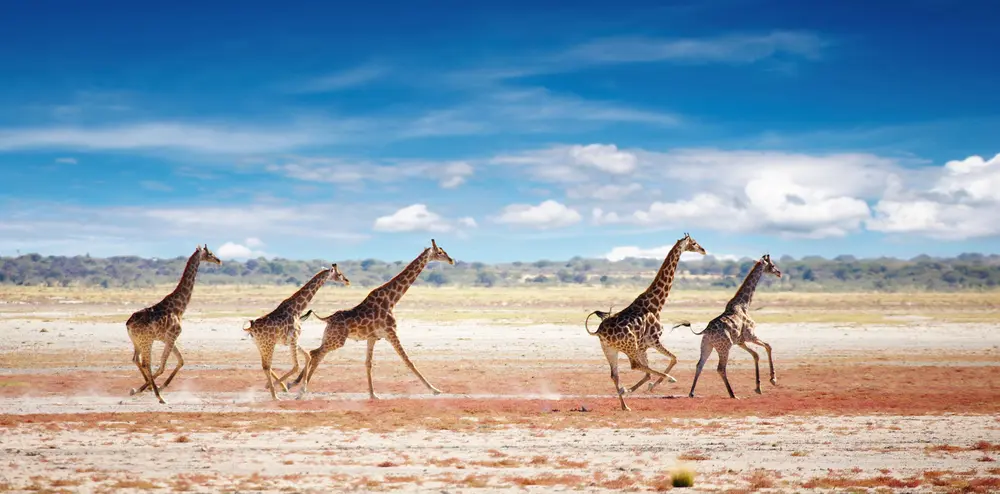
Giraffes can jump, but it is not something they do naturally or often. Their height and body structure make jumping difficult, though they are physically capable of clearing obstacles of about 1.5 to 1.8 meters (5 to 6 feet) when necessary. Even then, their movements are far less agile than most mammals.
Instead of leaping, giraffes are built for stability, long-distance movement, and speed across open landscapes. Let’s discuss this in detail!
Key Takeaways
- Giraffes can jump, but they rarely do it naturally
- They are capable of clearing obstacles of about 1.5 to 1.8 meters (5 to 6 feet) when necessary
- Their height, long legs, and body structure make jumping difficult and inefficient
- Giraffes are built for stability, speed, and long-distance movement rather than leaping
- Wildlife researchers rarely observe giraffes jumping in the wild
- Giraffes rely on long strides, endurance, strong vision, and powerful kicks for survival
- Large mammals like elephants also rarely jump because of body size and balance limitations
- Habitat loss, poaching, and human expansion are bigger threats to giraffes than physical limitations
- Conservation efforts from organizations like Save Giraffes Now help protect giraffe populations and their habitats

Can Giraffes Actually Jump?
Technically, yes. Giraffes are physically capable of jumping, but they rarely do it naturally.
Unlike animals built for leaping, giraffes rely on long strides and speed to move across open landscapes. Their body structure is designed for efficient forward movement rather than vertical lift.
Wildlife researchers and conservationists rarely observe giraffes jumping in the wild. Even when approaching barriers or uneven terrain, giraffes are more likely to walk around obstacles than attempt to jump over them.
This has led to the common belief that giraffes cannot jump at all. The reality is more nuanced. They can jump if necessary, but their anatomy makes it an impractical and uncommon behavior.
Why Don’t Giraffes Jump?
A giraffe’s body is not designed for jumping.
Their long legs and tall frame create a very high center of gravity, which makes balance more difficult during upward movement. Jumping would place significant stress on their joints and increase the risk of falling or injury.
Their neck also plays a role. A giraffe’s body must stay stable to support blood flow and coordination, especially while moving at speed. Sudden vertical motion can disrupt that stability.
Energy efficiency matters too. In the wild, giraffes survive by conserving energy and moving efficiently across large areas. Jumping offers little advantage in open savanna environments where running and visibility are more important.
Instead of leaping, giraffes rely on the following:
- Long, efficient strides
- Speed and endurance
- Strong vision to detect danger early
- Powerful kicks for defense
These traits are more useful for survival than jumping.
How Do Giraffes Move Instead of Jumping?
Giraffes move using a specialized gait that helps them stay balanced while covering large distances.
When walking, both legs on the same side of the body move together. This creates the slow, swaying motion giraffes are known for. At faster speeds, they shift into a gallop, where the front and back legs move in coordinated patterns to maintain stability.
Despite their size, giraffes can run surprisingly fast. They can reach speeds of up to 35 miles per hour (56 km/h) over short distances.
Are Giraffes the Only Mammals That Rarely Jump?
No, but they are among the few large mammals that rarely jump.
Elephants are another example. Unlike many mammals, elephants cannot truly jump because their size, weight, and leg structure make it difficult for all four feet to leave the ground at once. Both animals rely on stability and forward movement instead of vertical motion.
This pattern is common among very large land animals. As body size increases, jumping becomes more difficult because of the stress placed on bones, muscles, and joints.
Giraffes take this even further because of their extreme height and long limbs. Their anatomy prioritizes balance and efficient movement across open terrain rather than rapid directional changes or leaping.
Could a Giraffe Jump Over a Fence?
In theory, a giraffe could jump over a low obstacle, but they rarely choose to.
Most giraffes avoid jumping entirely, even when faced with fences or barriers. Instead, they usually stop, turn around, or look for another route.
This behavior is one reason many wildlife reserves use relatively low fencing for giraffes. The animals generally do not attempt to leap over it unless they become extremely stressed or frightened.
The risk of injury is simply too high. A bad landing could damage their legs or joints, which are essential for survival in the wild.
What Happens When Giraffes Run?
Running places enormous demands on a giraffe’s body, which is why their movement is highly specialized.
During a gallop, a giraffe swings its neck forward and backward to help maintain balance. This motion works almost like a counterweight, helping stabilize the body while moving at high speed.
Their long legs allow them to cover ground quickly with fewer strides. Instead of explosive jumps, giraffes depend on momentum and endurance to escape danger.
This movement style is highly effective in open habitats. Predators are easier to detect from a distance, giving giraffes time to run before a threat gets too close.
Help Protect the Animals Built to Survive the Wild!
Giraffes may not be built for jumping easily, but they are perfectly adapted for life in open savanna ecosystems. Their height, balance, speed, and endurance all work together to help them survive in environments where visibility and movement matter more than agility.
The real threat to giraffes is not their inability to leap over obstacles. It is habitat loss, poaching, and the growing pressure of human expansion across the landscapes they depend on. These challenges are contributing to what many conservationists describe as a silent extinction, with giraffe populations declining in several regions across Africa.
We are working to change this through habitat protection, anti-poaching efforts, and conservation programs focused on protecting vulnerable giraffe populations at Save Giraffes Now.
Protecting giraffes means protecting the ecosystems they are built for. Donate now to help make this possible.
Frequently Asked Questions
How high does a giraffe jump?
Giraffes can clear obstacles of about 1.5 to 1.8 meters (5 to 6 feet) when necessary. However, jumping is extremely uncommon because their bodies are not built for vertical movement.
Can a giraffe grab a human?
No. Giraffes do not have hands or grasping limbs, and they are not predators. They may investigate objects or people with their long tongues, but they cannot grab humans.
Who is a giraffe’s enemy?
Lions are the main natural predators of giraffes, especially calves. Humans are also one of the biggest threats to giraffes today through habitat loss, poaching, and human expansion.